


There are a lot of excuses for avoiding the weight room: endurance athletes worry that it competes with precious sport-specific training time; some fear getting too bulky; cardio kings and queens just love logging long endurance sessions; and others simply don’t know how to begin.
If any of the above describe you, you’re doing your health - and your performance - a disservice by eschewing strength training. The truth is that weightlifting is crucial for long-term health, fitness, and aging well, and it can also be an asset to cardio-focused athletes.
Why Trust Us?
ACTIVE.com's editorial team relies on the knowledge and experience of fitness and wellness experts, including competitive athletes, coaches, physical therapists, nutritionists, and certified trainers. This helps us ensure that the products we feature are of the highest standard. Collectively, the team has spent countless hours researching equipment, gear, and recovery tools to create the most accurate, authentic content for our readers. Customer satisfaction is also a key part of our review process, which is why we only feature highly rated products.
The Benefits of Regular Strength Training
Building a workout regimen that includes a variety of exercise types is key to living a long and healthy life, but if you could do only one type of exercise, science says you should choose strength training. That’s because, as we age, our strength, power, and muscle mass decline more rapidly than our aerobic capacity. What’s more, a significant portion of the decline in aerobic capacity can be attributed to the loss of muscle.
A multitude of research has found strong health-related benefits of regular strength training, including:
- Improved metabolic health and lower risk of Type-2 diabetes, metabolic syndrome, and cardiovascular disease
- Better mobility, physical function, and independence
- Better bone health and lower risk of osteoporosis
- Better body composition and weight management
- Improved cognitive function
How Strength Training Can Boost Performance for Endurance Athletes
A 2022 systematic review found that resistance training improved multiple measures of cardiorespiratory fitness, including VO2max. To learn more about why, we reached out to two coaches well-versed in how strength training can boost endurance athletes' performance.
So, you obviously have the general pre-hab and injury prevention aspects of strength training. But what’s not as well known in the endurance community is that maximal strength training can actually improve endurance performance.
Reid, who is Head of Content and Training for the online fitness education and coaching site Absolute Endurance, who holds licenses with USA Cycling, Stryd Power Running and TrainingPeaks, agreed. According to Seacat, the neuromuscular benefits of resistance training benefit endurance performance more than the outright strength benefits.
“These adaptations lead to better muscle recruitment, better stiffness where appropriate, better force application, and less decline in mechanics as fatigue builds. In a nutshell, a stronger muscle can produce more force faster and with less relative effort.”
How to Get Started and How to Progress
Both coaches stressed that heavy, or even maximal, lifting is more beneficial than a low-weight/high-repetition protocol.
"The research is quite consistent that heavy loads tend to outperform lighter ‘toning’ work for economy and performance outcomes,” Seacat says. Both he and Reid described this as at least 80 percent and up to 90 percent of your one-rep maximum (1RM) weight. If you don’t know your 1RM, which most of us don’t, stop when you feel like you could only do one or two more repetitions with good form.
Seacat recommends targeting two to four exercises fundamental to your sport. “For most endurance athletes, this leads to some combination of squat or deadlift, Romanian deadlift or hinge variation, split squat or lunge, step-up, and then smaller doses of calf work, hamstring work, and core/trunk stability.”
The eventual goal is to do between two and five sets of just 3 - 6 reps for each exercise twice per week, though Seacat noted that it’s “typically better to start lighter on a weight and work up from there,” especially if you’re new to weightlifting. Reid also stressed the importance of long rest periods of two to five minutes between each set, so that you’re able to produce maximum force for best results each time.
Both coaches also noted that if you’ve got time, adding plyometrics, or explosive moves like box jumps, squat jumps, high skips, etc., can be very beneficial for athletes.
When you do these sessions, it is as important as how and how often you do them. “Protect your key session,” Reid cautioned, “meaning keep it at least 48 hours away after a strength session. Early in the season, that might be your long run. As the season progresses, it could shift to something like a tempo or threshold workout. Whatever that key session is for your current phase of training, you want to make sure you’re performing it fresh and not carrying any fatigue from strength work.”
Other Tips to Bear in Mind
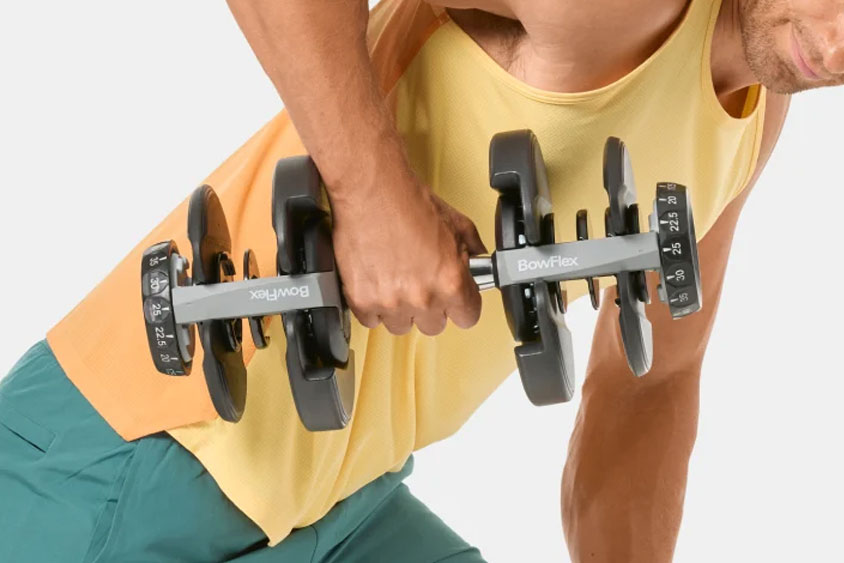
If you’ve never worked with a strength coach or knowledgeable mentor, you’ll save yourself a lot of guesswork and potential serious injury by finding one, at least for your first couple of months of strength training. Once you’ve learned proper technique and form, and how to dial in sets, reps, and recovery intervals, you can go it alone. Bowflex 552 Select Tech dumbbells are a great way to get a full-body workout at home, especially if space is a consideration. (For more tips on setting up your home gym, check out this article.)
Finally, while you might be motivated to start strength training to improve your current athletic performance, Seacat noted that “Endurance athletes are very good at accumulating aerobic work, but may be under-performing on the type of strength work that helps preserve lean mass over the long haul.”
Rather than only focusing on the next event or your chosen sport, he says strength training “should also be viewed through the lens of what helps life-long athletes stay healthy, functional, and physically confident for decades.”
By clicking on the product links in this article, we may receive a commission fee at no cost to you, the reader. Sponsorships and affiliate commissions help support our research so we can help you find the best products. Read full affiliate disclosure here.