

How to Train for Open Water Swimming: Making the Leap from the Pool
You've put in the work in the pool sessions. You can hold a steady pace, you're not gasping for air after every length, and you've got your stroke feeling reasonably solid. Then someone mentions the open-water swim at your upcoming triathlon, and your stomach drops. Sound familiar?
Why Trust Us?
ACTIVE.com's editorial team relies on the knowledge and experience of fitness and wellness experts, including competitive athletes, coaches, physical therapists, nutritionists, and certified trainers. This helps us ensure that the products we feature are of the highest standard. Collectively, the team has spent countless hours researching equipment, gear, and recovery tools to create the most accurate, authentic content for our readers. Customer satisfaction is also a key part of our review process, which is why we only feature highly rated products.
The jump from pool swimming to open water swimming is one of the most common anxiety points for age-group triathletes. We know what it feels like to stand at the edge of a murky lake in a wetsuit, wondering how something that felt manageable in the pool suddenly feels so foreign.
The good news is that knowing how to train for open water swimming is completely learnable, and the swim training you've already done gives you a real foundation to build on.
- Why open water swimming feels so different
- The three core swim techniques that matter most when conditions get unpredictable
- How to practice sighting, drafting, and race starts
- What to expect on your first open water swim
- Wetsuit basics
- How to warm up before an open water swim
- Why comfort in open water matters more than fitness
Why Open Water Swimming Feels Nothing Like the Pool
Most triathletes assume that pool swimming and open water swimming are basically the same thing, just with different scenery. They're not. Open water is a fundamentally different environment, and understanding why will help you stop being surprised by it and start preparing for it properly.
What Pool Swimming Doesn't Prepare You For
The pool is a controlled, predictable environment. The bottom of the pool has a black line to follow. The walls give you a reference point every 25 meters. Lane lines dampen waves and keep other swimmers out of your space. You can see your hands in front of your face. None of that exists in open water.
Pool swimmers who move to open bodies of water for the first time often discover their fitness is fine, but their environmental management is zero. Here's what the pool simply doesn't prepare you for:
- No black line on the bottom of the pool to follow, you have to navigate entirely on your own
- No walls to push off, you're swimming the full distance without a break or reset
- No lane lines to dampen chop, waves from wind, boats, and other swimmers are constant
- Murky or dark water that limits visibility, sometimes you can't see your hands at all
- Other swimmers swimming over, under, and into you, especially at race starts
- A wetsuit that changes how your body feels in the water and restricts shoulder movement
- Variable water conditions, currents, chop, cold water temperature, and low visibility all in the same race
The Three Swim Skills That Transfer From Pool to Open Water
Before adding open-water-specific skills, make sure your pool technique foundation is solid. These three principles matter most when the environment gets unpredictable; if they break down in the pool, they'll break down in open water too.
Breathe Like a Dolphin: Staying Calm When the Water Gets Choppy
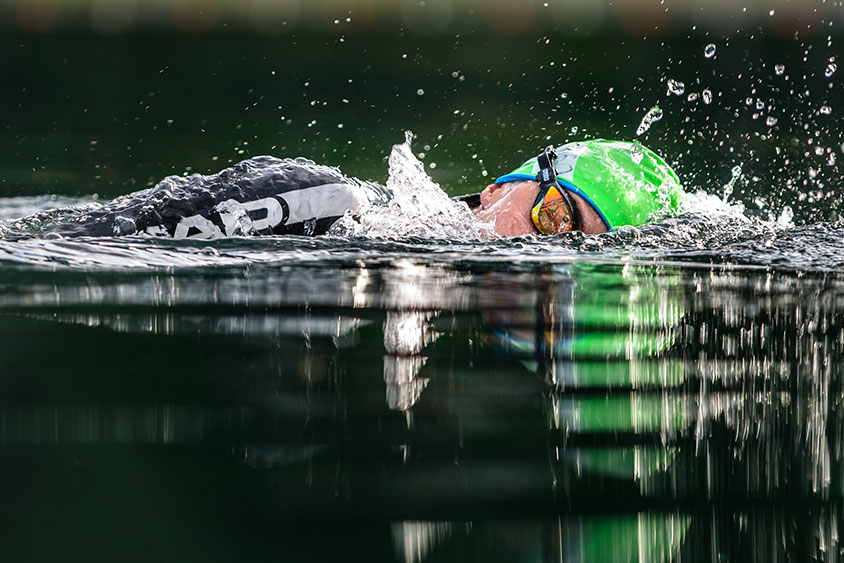
Controlled breathing is the single most important swimming skill for open-water swimming. When conditions get rough or another swimmer's feet end up in your face, breathing breaks down first, and panic follows.
The fix is training a calm exhale-and-sip pattern in the pool until it's completely automatic:
- Exhale continuously the entire time your face is in the water; never hold your breath
- Take only a small sip of air when turning to breathe, not a gasp
- Breathe every two strokes to maximize oxygen
- Turn your head, don't lift it, one goggle stays in the water
Float Like a Log: Why Body Position Matters Even More in Open Water
The pool masks poor body position. Open water doesn't. Sinking legs create drag, slow you down, and drain energy before the bike and run even start. The goal is a firm, horizontal body line, back of the head, hips, and heels at the surface of the water.
Common faults to eliminate:
- ❌ Lifting your head to breathe drives your legs down like a seesaw
- ❌ Wide or aggressive kick, burns oxygen, while increasing drag
- ❌ Relaxed core, causes the body to wiggle and creates drag
Race Like an Arrow: Swimming Straight Without a Black Line to Follow
Without a black line to follow, most triathletes naturally drift. GPS data shows that age-groupers regularly add 10–20% to their actual course distance. In a 1,500-meter open water swim, that's up to 300 extra meters.
Swimming straight requires good stroke alignment and sighting, both of which need to be trained in the pool before race day. The most common causes of swimming off course:
- A hand crossing the center line on entry causes the hips to sway
- Breathing only to one side gradually pulls the body off course
- Never practicing sighting, no way to check and correct direction mid-race
Open Water-Specific Skills You Need to Train in the Pool
Once the foundational swim technique is solid, three open water-specific skills can and should be done in the pool before race day. You're training these in a controlled environment, so they're automatic when the environment gets uncontrolled.
How to Practice Sighting Without Going to Open Water
Sighting is the skill of briefly lifting your eyes forward to spot a buoy or landmark while you're swimming, without breaking your stroke or body position. It sounds simple. It's not, at least not at first. Most new triathletes either don't sight at all (and swim off course) or lift their head forward too high (which drives the legs down and creates drag). Done wrong, it costs time and energy. Done right, it keeps you on the shortest distance between start and finish.
The key is lifting only the eyes, not the full head, just high enough to see forward, then immediately rotating to breathe as normal. Practice sighting in the pool using this sequence:
- Push off the wall and begin swimming normally
- Every 6–10 strokes, lift just your eyes (not your chin) forward to look ahead, as if you're trying to see over a low fence
- Immediately rotate your head to breathe on your normal side as you would any other stroke
- Continue swimming without breaking rhythm
- Practice this as one-length drill, one-length swim sets, focusing on sighting during the drill length, then carrying the habit into the swim length.
- Build to sighting every 6 strokes comfortably before taking it to open water.
Drafting in Open Water: What It Is and How to Use It
Drafting, swimming close behind or just off the hip of another swimmer, reduces drag and can meaningfully cut the effort required to hold the same pace. For most age group triathletes, the benefit of a good draft is modest but real. The mistake is chasing a draft at the expense of swimming your own race.
The best draft position isn't directly behind another swimmer; it's just off to the side, with your hand entering the water near their hip. This gives you the hydrodynamic benefit without putting you directly in their kick zone (and their feet in your face). The critical thing to remember: drafting only works if the swimmer in front of you is going straight. If they're off course, you're off course too.
Drafting tips for open water triathlon swimming:
- Best position: just off to the side with your lead hand entering near the lead swimmer's hip
- Keep sighting even while drafting; the person in front of you may be swimming off course
- Don't chase a draft at the cost of your own rhythm and breathing pattern
- Practice swimming close to others in the pool to get comfortable with proximity before race day
- If the swimmer you're drafting off slows down, be ready to move around them without disrupting your pace
Swim Start Chaos: How to Prepare for the Triathlon Washing Machine
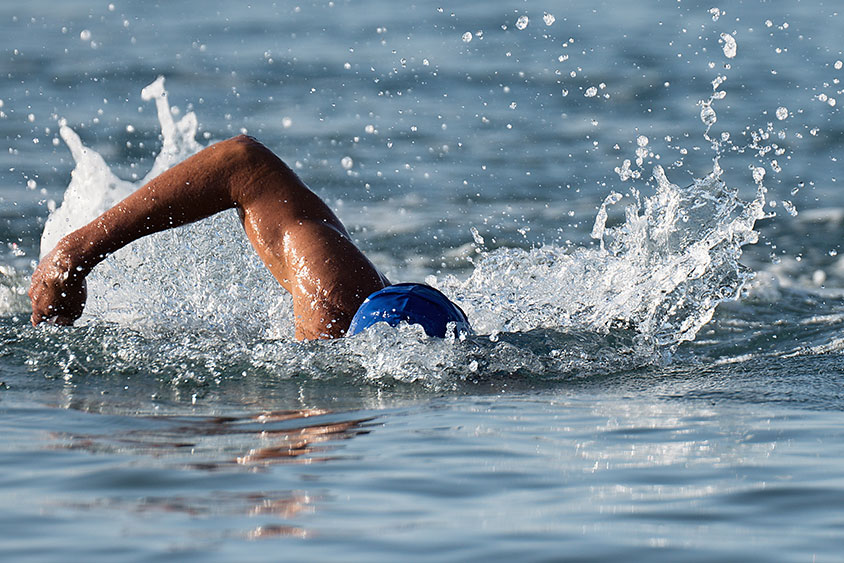
The triathlon swim start, particularly a mass start, is genuinely unlike anything pool swimmers have experienced. Hundreds of swimmers are hitting the water at once, everyone surging for position, getting kicked, bumped, swum over, and occasionally pushed under. Heart rates spike. Breathing breaks down. Athletes who were calm in training suddenly find themselves in survival mode at the edge of a body of water.
,br/> The best preparation is getting comfortable with contact and with race-pace effort in training. Swimming with a training buddy nearby, doing race-start simulations (hard effort for the first 100–200 meters), and practicing breathing at elevated heart rates all build the tolerance you need. Knowing what to expect takes away much of the psychological shock.
Race start strategies based on comfort level:
Less confident open water swimmers:
- Start at the very side edge of the swim start, minimal contact, and you only swim an extra meter or two
- Start at the back and let the main group go, you'll have clear water and can swim your own race
- Either option loses minimal time compared to stopping mid-swim from panic
More experienced open water swimmers:
- Seed yourself 1–3 minutes faster than your expected swim time in wave or rolling starts
- Position near but not at the front, avoid the most aggressive contact while still accessing a draft
- The fastest draft position is off the hip of a swimmer going straight, sight to verify before committing
Your First Open Water Swim: What to Expect and How to Prepare
No amount of pool training fully replaces the experience of actually getting into open water, but going in prepared makes all the difference between a confidence-building experience and a difficult one. Here's what to know before your next open water swim.
Wetsuit Basics for Open Water Triathlon Swimming
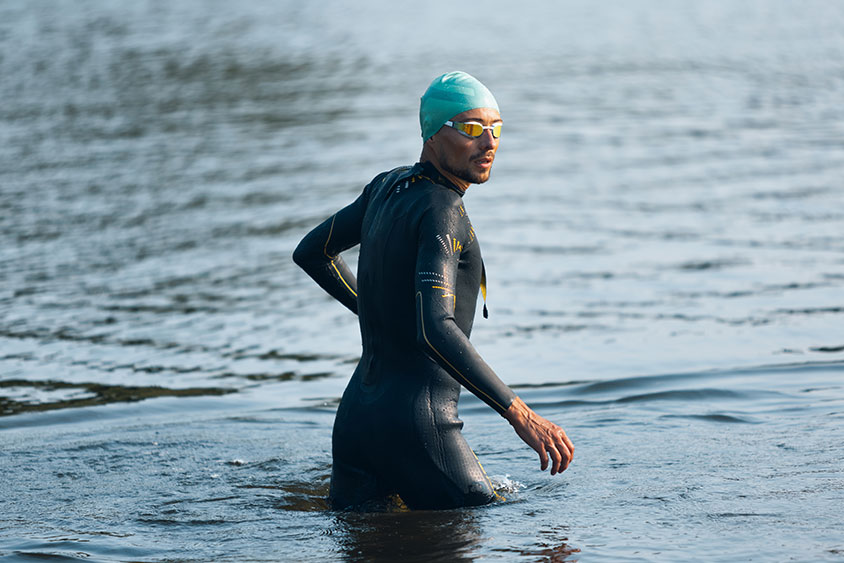
A wetsuit is almost always worth using for open water triathlon swimming, full stop. It adds buoyancy (which directly improves body position and helps you stay at the water’s surface), provides warmth, and gives most swimmers a real psychological boost. Even experienced open water swimmers are faster in a wetsuit than without one.
Always choose a sleeved wetsuit over a sleeveless one. The armpits are a major source of heat loss while swimming, and sleeveless wetsuits leave them completely exposed. A sleeved wetsuit that fits correctly, tight in the body but with a little extra neoprene bunched at the shoulder for range of motion, will keep you warmer and faster.
Wetsuit tips for triathlon open water swimming:
- Practice in your wetsuit before race day; never put it on for the first time at a race
- Bunch a little extra neoprene at the shoulder to ensure a full range of motion during your stroke
- Get in the water before the race starts to let water into the wetsuit and get used to the feel
- If you feel constricted across the chest, the wetsuit may be too small. Try the next size up
- After the swim, practice wetsuit removal in training, so it should come off in seconds in transition
How to Warm Up Before an Open Water Swim or Race
A pre-swim warm-up is one of the most underused tools in triathlon, and one of the most impactful things you can do for your open water swim. Getting in the water before the race lowers your initial heart rate spike when the gun goes off, reduces the shock of cold water temperature, and, most importantly, gets your breathing pattern dialed in before hundreds of other swimmers surround you.
Even 5–10 minutes of warm-up swimming makes a significant difference. Knowing what to expect from the water, having felt the temperature, and having gotten your heart rate up and back down means you start the race in control rather than in shock.
Simple pre-race warm-up routine:
- 3 minutes easy swimming, just get comfortable and get the breathing pattern established
- Gradually build effort: 5 strokes fast / 25 easy → 10 fast / 20 easy → 15 fast / 15 easy → 20 fast / 10 easy
- Focus on breathing, make sure the exhale-and-sip pattern is automatic before the start
- After warming up, stay active on shore, bounce, shake out your arms, and keep your heart rate slightly elevated
If water access isn't available before the race:
- Use TheraBands or stretch cords to activate swim muscles, 3–5 minutes, gradually increasing speed
- Splash water on your face and down your wetsuit at the water's edge, which eliminates the cold shock response
- Keep moving while waiting, bouncing, and light movement keeps your heart rate up and body warm
- Pro tip from two-time Kona champion Patrick Lange: have someone on your crew with a thermos of warm water to pour down your wetsuit before the start in cold conditions
The Final Stretch
Open water swimming is a learnable skill, and the fact that you find it intimidating doesn't mean you're not ready for it. It means you haven't trained for it specifically yet. That's all.
The foundation starts in the pool: get your breathing automatic, get your body position horizontal, and get your stroke moving in a straight line. Then layer on the open water-specific skills, sighting, drafting, race start comfort, and practice them in training before you need them in a race. Add a wetsuit, do a proper warm-up, and go into your next open water swim knowing what to expect. That's the whole system. Thousands of age-group triathletes make this leap every year, starting from exactly where you are right now. With the right approach, you will too. If you're ready to train with a plan built around these exact principles, sign up for a free, personalized MOTTIV swim training plan today, designed to take you from pool swimmer to confident open-water swimmer, step by step.