

If you've signed up for a half Ironman or full Ironman and you're quietly wondering whether your body can actually get there, you're not alone. I've been in that spot, and so has every age-group triathlete I've ever worked with.
The gap between where you are right now and what a 70.3 or 140.6 demands is real, but it's also completely bridgeable. Figuring out how to build endurance for long-distance triathlons is a learnable, systematic process, and your body is more capable of adapting to it than you think.
This article covers what long-distance triathlon endurance actually requires, how to structure your training to build it, and what to focus on in the swim, on the bike, and on the run.
Why Trust Us?
ACTIVE.com's editorial team relies on the knowledge and experience of fitness and wellness experts, including competitive athletes, coaches, physical therapists, nutritionists, and certified trainers. This helps us ensure that the products we feature are of the highest standard. Collectively, the team has spent countless hours researching equipment, gear, and recovery tools to create the most accurate, authentic content for our readers. Customer satisfaction is also a key part of our review process, which is why we only feature highly rated products.
Why Building Endurance for a Distance Triathlon Is Different
Sprint and Olympic distance racing are hard, but they're hard in a way that raw fitness and adrenaline can mostly carry you through. A sprint triathlon takes most age-group athletes between one and two hours. A 70.3 takes four to seven. The 140.6 can take eight to seventeen. At those durations, the physical demands shift completely, and the training that got you ready for shorter races stops being enough.
The biggest shift is metabolic. At long distances, your body has to become efficient at burning fat as fuel because glycogen stores run out. Athletes who haven't trained this system will feel fine for the first half of a 70.3 and then fall apart on the run, not because they aren't fit, but because their bodies never learned to use fat efficiently at race intensity. Top-end cardiovascular fitness alone won't save you in a long-distance tri.
The other factor is compounded fatigue across three disciplines. Running two hours on fresh legs is manageable. Running two hours after a 90-minute swim and a six-hour bike ride is a completely different challenge. Your legs are already loaded, your gut has been working for hours, and your mental reserves are depleted. Building endurance for a long-distance triathlon means training your body to handle all of that in sequence, not just training each sport in a vacuum.
How Many Hours Per Week Do You Actually Need?
Most athletes overestimate what peak weeks require and underestimate how much the base phase matters. Consistency over months beats heroic single weeks every time. Three months of steady, well-structured training will do more for your endurance than one massive overload week followed by two weeks of exhaustion.
Here are realistic weekly training hour ranges by race distance and phase:
70.3 weekly hours:
- Base phase: 6 to 9 hours
- Build phase: 9 to 12 hours
- Peak phase: 11 to 15 hours
- Taper: 5 to 7 hours
140.6 weekly hours:
- Base phase: 8 to 11 hours
- Build phase: 12 to 15 hours
- Peak phase: 15 to 20 hours
- Taper: 7 to 10 hours
These are ranges, not targets. Hitting the lower end consistently every week is far more valuable than occasionally hitting the upper end and needing 4 days to recover.
The Long Workout: Your Most Important Session of the Week
No single training session does more for long-distance endurance than the weekly long effort in each discipline. These sessions teach your body to burn fat efficiently, build muscular endurance in triathlon-specific movement patterns, and develop the mental toughness that keeps you moving when everything hurts. Shorter workouts build fitness. Long workouts build the specific stamina a 70.3 or 140.6 demands. The key is that long sessions are done at low intensity, almost always Zone 1 or 2 (a 3 to 4 out of 10 effort, rate of perceived exertion, or RPE). Going too hard turns a long endurance session into a hard session, which is an entirely different training stimulus. You build up too much fatigue and physiological stress to recover in time for the next workout, and you don't perform at your best in the hard workouts, so you don't adapt to them nearly as much as you need to.
The goal of long workouts is to spend time in the saddle and on your feet at an aerobic effort, not to accumulate fatigue.
Long Bike Rides
The long ride is the cornerstone of triathlon endurance training, and for good reason: it builds endurance not just for the bike leg but for the entire race. You can gradually increase your bike time to lengths that would be impossible or dangerous to replicate in swimming or running. This is the over-distance concept: you ride longer than the race itself so that the actual bike leg feels manageable by comparison.
- 70.3: Build your peak long ride to 110 to 130 km at an easy Zone 2 pace, with the final 25 to 30 percent gradually adding race-pace effort in the last 8 to 12 weeks before your event
- 140.6: Build toward a 6-hour long ride as your peak; once you've trained past that threshold, your body can sustain effort for the full race distance
- Intensity: The majority of every long ride should feel easy; resist the urge to push
- Progression: Increase long ride distance 7 to 10 percent per week, then take a shorter rest week every third week before building again
- Nutrition practice: Use every long ride to practice your race day fueling; treat it as a mandatory part of the session Long Runs
The long run is typically done on legs already carrying the week's training load, and that's intentional. Running on fatigue trains your body to hold form and effort when fresh legs are long gone, which is exactly what race day demands. It also means the long run requires more care than the long ride: running places three to four times your bodyweight through your joints with every stride.
- 70.3: Build your peak long run to 120 minutes; running beyond that increases injury risk without meaningful additional endurance benefit
- 140.6: Build to 3 to 3.5 hours at most; your longest run in training does not need to match the full race distance
- Effort: Keep it conversational, Zone 2 throughout; if you can't hold a sentence, you're going too hard
- Progression: Gradually increase by 10 minutes every one to two weeks, with a shorter run every third week
- Brick runs: Once each week, follow your long ride with a 15 to 50-minute run immediately after to train the bike-to-run transition
Long Swims
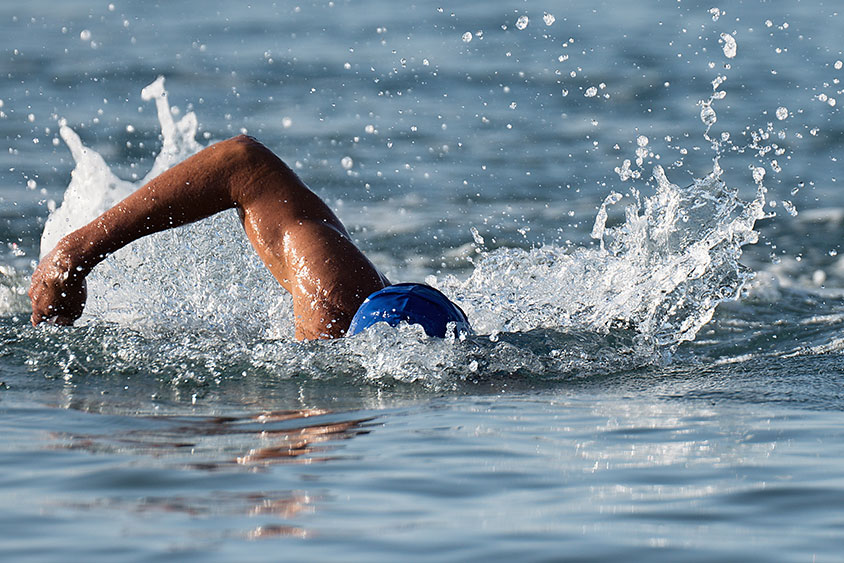
The long swim is the most underestimated session of the three. Many athletes assume that being a competent pool swimmer means they're ready for an open-water race, but the two are genuinely different skills. The long swim builds open water comfort, stroke efficiency over extended distances, and the specific muscular endurance your shoulders and lats need to sustain output for 40 to 90 minutes in race conditions.
- 70.3: Build to 3,000 to 3,500 meters as your peak long swim
- 140.6: Build to 4,000 to 5,000 meters as your peak long swim
- Pacing: Swim at a steady, sustainable effort; long swims are not for pushing pace
- Technique: Include sighting practice and bilateral breathing in every long swim session
- Open water: Replace at least one long pool swim per month with an open water swim once conditions allow
How to Use Interval Training to Build Triathlon Endurance
Long, slow distance alone does not build all the endurance you need. Without high-intensity work layered on top, your aerobic ceiling stays low, and race pace will always feel harder than it should. Interval training raises that ceiling by pushing your cardiovascular system to work at efforts above race pace, which makes race pace feel more sustainable over time.
Three types of interval work matter most. Aerobic threshold intervals are performed just below your lactate threshold and help your body clear lactic acid more efficiently during sustained efforts. VO2 max intervals push into hard effort for short bursts of 3 to 8 minutes and expand your aerobic capacity ceiling. Race-pace intervals are done at your goal race effort, and train your body to recognize and hold that specific output under fatigue.
These sessions are short and strategic, done once per week per discipline. The long sessions and the interval sessions serve different purposes. Mixing them produces neither endurance nor speed.
Example interval sessions:
- Swim: 8 x 100m at hard effort with 20 seconds rest, or 4 x 400m at race pace with 45 seconds rest
- Bike: 5 x 8 minutes at a challenging Zone 4 effort with 3 minutes easy between each, or 3 x 15 minutes at race pace with 5 minutes easy between
- Run: 6 x 4 minutes at a hard effort with 2 minutes walking recovery, or 4 x 1 mile at half-marathon pace with 90 seconds recovery.
Strength Training for Endurance Athletes
Strength training is not a supplement to triathlon training. For long-distance athletes, it is part of the foundation. It builds the specific muscular resilience that keeps your bike power output from fading in the final hour of the ride, prevents your running form from collapsing at kilometer 15 of the half-marathon, and reduces the risk of overuse injuries that accumulate from hundreds of hours of repetitive motion over the course of a season.
One or two 30- to 45-minute sessions per week are enough. The exercises that matter most are the ones that strengthen the specific muscles triathletes use and chronically neglect.
- Single-leg squat: Builds unilateral leg strength that translates directly to bike power and running stability.
- Romanian deadlift: Strengthens the posterior chain, glutes, and hamstrings, which are underdeveloped in swimmers and cyclists.
- Hip thrust: Targets glute activation, the most important muscle group for run economy and late-race bike power.
- Single-leg calf raise: Builds the ankle and lower leg resilience that prevents Achilles and plantar issues in the long run.
- Plank and dead bug variations: Develop the core stability that holds your bike position and form together under fatigue.
- Pull-ups or lat pulldowns: Build the pulling strength that supports swimming stroke efficiency over longer distances.
- Mobility work: 15 to 30 minutes of hip opening and movement work, particularly beneficial for cyclists in a compressed position for hours at a time.

Nutrition Strategies That Support Long-Distance Training
Nutrition is the fourth discipline of triathlon, and at the long-distance level, it matters as much as your swim, bike, and run training. During heavy training weeks, carbohydrate needs are high because it is the primary fuel for moderate-to-hard efforts. Under-fueling daily, even on easy days, digs a hole that compounds over weeks and leaves you chronically flat in your sessions.
The bigger mistake I see athletes make is treating nutrition during long sessions as optional. Your body can sustain effort without carbohydrate intake for roughly 60 to 90 minutes before performance starts to drop. Any long ride or long run beyond that needs nutrition taken on a schedule, not when you feel like it. Practice this in training because your race-day nutrition plan should never be something you're testing for the first time.
Key nutrition rules for long-distance triathlon training:
- Eat within 30 minutes of finishing every workout, particularly long sessions
- Fuel during any session longer than 75 to 90 minutes: aim for 60 to 80 calories every 20 to 30 minutes
- Match daily carbohydrate intake to training load: more on long and hard days, less on easy days
- Practice race nutrition in training using the same products, timing, and quantities you plan to use on race day
- Hydrate according to a schedule: roughly 500 to 750 ml of fluid per hour, depending on heat and sweat rate
- Include electrolytes in any session over an hour; sodium loss accelerates fatigue and causes cramping that no amount of fitness can overcome
Recovery Is Part of the Training, Not a Break From It
The adaptation you're chasing happens during recovery, not during the workout. The workout is the stimulus. Sleep, rest, and easy days are when your body rebuilds stronger than before. Most age-group athletes I work with under-recover far more than they underperform in their workouts. They do the hard sessions, then fill every other day with an "easy run" that quietly turns into a moderate effort, and wonder why they feel flat heading into the weekend.
Adequate recovery means protecting sleep above almost everything else. More than seven hours per night is the minimum, not a luxury. It means taking easy days seriously and keeping up the effort even when you feel good. It means scheduling a shorter recovery week every third or fourth week so your body can absorb the training load before you build again.
- Sleep more than 7 hours per night consistently; this is the single most powerful recovery tool available.
- Protect at least two genuinely easy days per week; these sessions should feel almost embarrassingly slow.
- Take a recovery week every third or fourth week, dropping volume to roughly 60 percent of the previous week's load.
- Eat within 30 minutes of finishing hard sessions; delaying recovery nutrition extends the time your body stays in a catabolic state.
- Watch for warning signs: persistent fatigue, poor sleep, workouts feeling harder than they should, and mood changes are all signals to pull back, not push through.
Race-Specific Endurance: Pacing for Your Goal Event
All the endurance you've built in training can be undone on race day by poor pacing. It's the single most common way well-prepared athletes' good races fall apart. The core challenge at both distances is that you'll feel good early, and your emotions will push you to go too fast. Your job is to hold back when everything in your body is telling you to go.
Half Ironman Endurance Strategy
The 70.3 is where pacing starts to get genuinely critical. An error in effort on the bike can turn the run into a suffer-fest from the first kilometer. I learned this at IM 70.3 Campeche in 2017: I felt great off the bike and ran the first five kilometers 30 seconds per kilometer faster than my target. By the end, I was running over a minute per kilometer slower than my goal. Don't do what I did.
The target effort for the 70.3 sits at a 6 to 7 out of 10 across all three disciplines. Swim and bike pacing sets up the run, and the run is where races are won or lost.
- Swim: Start wide or at the back to avoid contact and find clear water; swim your own race at a controlled, steady effort; don't chase a draft at the cost of your breathing rhythm.
- Bike: Hold yourself back in the first half, particularly the first 30 minutes; the goal is to find the effort level that would lead to a bad run, then dial back five percent from there; practice this in training by finishing long rides at race effort, then running immediately after.
- Run: Run easy out of T2 for the first two kilometers no matter how good you feel; build to target pace by kilometer five and no faster; hold that pace to kilometer ten, then check in with your body; by kilometer 15 you should be working hard; aim for no more than a 10 to 15 second per kilometer drop in pace from start to finish.
Full Ironman Endurance Strategy
The 140.6 demands an even more conservative approach, and most athletes still get it wrong. The target effort drops to a 6 out of 10, which puts you at the top of Zone 2 to the very bottom of Zone 3 on the bike and run. This feels almost embarrassingly easy in the first hour. That's exactly right.
Before Challenge Roth, my coach told me to run 5:00 per kilometer, which was far slower than my training paces. He was right. I ran past people for the entire marathon because most athletes had gone out too hard and were walking by the halfway point. If you can keep a steady pace and run the whole marathon without stopping, you'll have a race you might never have thought possible.
- Swim: Warm up in the water before the gun goes off if at all possible; start wide to avoid the washing machine chaos; swim at a very slow effort to conserve energy. The swim is the shortest leg, and blowing up here costs you far more on the bike and run than any time you'd gain.
- Bike: Build gradually to just under race effort over the first five to seven minutes; spend the first half of the bike three to five percent under your target effort to assess how your body is responding on race day; bring it up to race effort at the halfway mark if you feel good; on hills, push five to fifteen percent harder going up and recover on the way down rather than trying to hold perfectly even effort.
- Run: Choose a pace that is a lot slower than you think you're capable of and use your heart rate as a ceiling; break the marathon into kilometer chunks mentally; hold your target pace for the first 30 kilometers without exception; only in the final 12 kilometers, if you still feel good, is it time to push.
The Final Stretch
Building endurance for a long-distance triathlon is not a secret. It's a process: long sessions done consistently at the right effort, interval work that raises your aerobic ceiling, strength training that keeps your body durable, nutrition that fuels the work, and recovery that lets the adaptation take hold. Every one of these principles is learnable, and every age-group athlete is capable of doing this.
The athletes who arrive at the finish line of a 70.3 or 140.6 feeling strong are not the ones who trained the most hours. They're the ones who trained consistently, recovered well, and trusted the process across months of preparation. That can be you.