

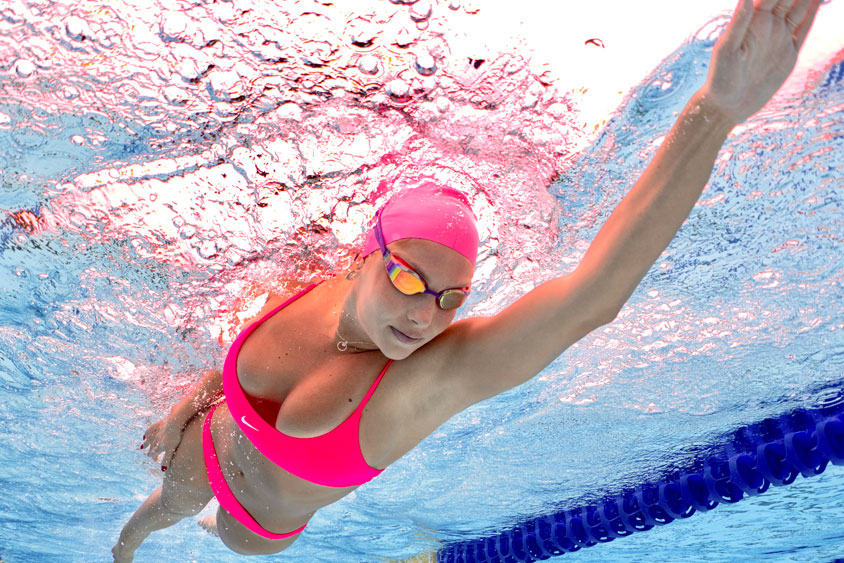
Photo by: Bryan Mineo
Quick answer: Engaging your core during freestyle helps connect your upper and lower body, maintain a long and stable position, and coordinate rotation through the hips and shoulders. Before each set, establish a neutral head position, keep your shoulders relaxed, and engage your torso as if holding a plank without creating excessive tension.
Why Trust Us?
ACTIVE.com's editorial team relies on the knowledge and experience of fitness and wellness experts, including competitive athletes, coaches, physical therapists, nutritionists, and certified trainers. This helps us ensure that the products we feature are of the highest standard. Collectively, the team has spent countless hours researching equipment, gear, and recovery tools to create the most accurate, authentic content for our readers. Customer satisfaction is also a key part of our review process, which is why we only feature highly rated products.
I consistently see swimmers of all abilities lacking core and torso awareness during freestyle. This may sound relatively inconsequential, but the core could be considered, well, the core of freestyle.
Intuitively, the strength and power of your arms and legs move you forward in the water. Less obvious is the core's role as the connecting piece between each moving part of your stroke. Without specific intention and focus on your core, you can limit your power potential and place more demand on your shoulders along the way.
For a broader look at the stroke, ACTIVE's freestyle swimming guide includes resources on breathing, body position, technique, and turns.
Why Does Poor Core Engagement Hurt Your Swimming?
Power and speed in swimming depend on your torso smoothly transferring force from the catch through the finish of the pull. If your core is not helping stabilize and connect your upper and lower body, it may feel as though your timing is off or you are forcing each pull and muscling each stroke with your shoulders.
This approach is less efficient, limits your power potential, and can contribute to excessive shoulder loading. Research involving adolescent swimmers with swimmer's shoulder syndrome also found lower core endurance in the affected group, supporting the connection between trunk stability and shoulder function.
Lacking core engagement may make your upper and lower body feel as though they are moving on two different planes. Your torso may twist, your legs may fishtail from side to side, and your body line may shorten in the water. Softer posture can feel like snaking through the pool, while taut, controlled posture creates length and supports alignment.
Quick Tip
How Do You Engage Your Core During Freestyle?
Visualize your body as a long, stable board, with your spine acting as the central axis. Aim to keep your upper and lower body connected as you rotate during freestyle: solid, stable, and coordinated.
Before pushing off the wall, activate your core as if you are holding a plank. This should feel actively engaged, but not strained as if you are performing crunches. Think form rather than flex. The goal is for your torso to stabilize your body while you maintain as much length as possible.
U.S. Masters Swimming describes an efficient freestyle body position as moving through the water like a torpedo and notes that the abdominals and obliques help keep the spine aligned. Its guidance also emphasizes that the spine should rotate together rather than in disconnected segments.
Think form rather than flex.
Use the Cue: Head, Shoulders, Hips, and Toes
Try this cue while swimming:
Head, shoulders, hips, and toes.
The familiar rhythm of the childhood song "Head, Shoulders, Knees and Toes" can help engrain a new movement concept. As you say each word, check in with that area of your body and make small adjustments as needed.
- Head: Keep it neutral rather than buried or lifted.
- Shoulders: Keep them relaxed and connected to the movement of your torso.
- Hips: Let them participate in the rotation rather than trailing behind your shoulders.
- Toes: Notice whether your legs are following your body's line or fishtailing side to side.
What Does It Mean to Lead Freestyle Rotation With Your Hips?
As you rotate from side to side, avoid letting your shoulder drive ahead of the hip on the same side. Leading every stroke only with the shoulders can create disconnection and mistiming, reducing the transfer of power through the arm stroke.
Instead, focus on initiating rotation through the hip and torso, then allow the shoulder and arm to follow naturally. Imagine your body as a boat, with the entire left or right side driving and rotating together. This coordinated side-to-side motion can help transfer force more smoothly through each stroke.
Body rotation is also necessary for effective freestyle mechanics. U.S. Masters Swimming explains that rotation helps position the arms for the pull and recovery, while a relatively straight spine allows the body to rotate as a connected unit.
Quick Tip
Try This 10-Second Posture Reset Before Every Set
Before you push off the wall, take a few seconds to check three points:
- Head neutral: Avoid burying your head or lifting it forward.
- Shoulders back and down: Keep your chest open without arching your lower back.
- Core engaged: Create a long, stable line without bracing so hard that you restrict your breathing or rotation.
With an engaged core and better alignment between your upper and lower body, you may feel smoother, more stable, and more connected through the stroke.
The Bottom Line
You may not need a total stroke overhaul to swim more efficiently. A better foundation can make a meaningful difference. Reset your posture, connect your hips and shoulders through the core, and focus on moving through the water as one coordinated unit.
Frequently Asked Questions
Should I tighten my abs while swimming freestyle?
Yes, but the engagement should feel supportive rather than rigid. Think about the controlled tension of a plank, not an all-out abdominal contraction. You should still be able to breathe and rotate smoothly.
How does core engagement improve freestyle?
Core engagement helps connect the upper and lower body, maintain alignment, support a longer body position, and coordinate rotation between the hips and shoulders.
Why do my legs fishtail when I swim freestyle?
Fishtailing can occur when the torso twists or when the hips and shoulders move out of sync. Focusing on a neutral spine, connected rotation, and a stable core may help reduce side-to-side movement.
Should freestyle rotation start from the hips or shoulders?
Think of the rotation as a coordinated movement through the hips, torso, and shoulders rather than a shoulder-only action. The goal is for each side of the body to rotate as a connected unit.
What is a quick core cue I can use before swimming?
Before pushing off, check your head, shoulders, hips, and toes. Keep your head neutral, shoulders relaxed, torso engaged, and legs aligned with the rest of your body.