

Whether you’re looking to complete or compete at your next triathlon, there’s one sure-fire way to shave time while racing: simple and speedy transitions. And you don’t have to work harder to go faster.
Why Trust Us?
ACTIVE.com's editorial team relies on the knowledge and experience of fitness and wellness experts, including competitive athletes, coaches, physical therapists, nutritionists, and certified trainers. This helps us ensure that the products we feature are of the highest standard. Collectively, the team has spent countless hours researching equipment, gear, and recovery tools to create the most accurate, authentic content for our readers. Customer satisfaction is also a key part of our review process, which is why we only feature highly rated products.
A few seconds saved here and there could add up to minutes off your T1 and T2, and ensure you won’t forget anything after you finish the swim portion of the race. If you train all season to go 10 seconds per mile faster in a 70.3 run, but then take too long in transition, you’ve negated these training gains!
Practice setting up your transition area, so you have fewer things to think about on race day. This may seem pedantic, but if you can get into a routine, you’ll be less likely to forget anything. Also, practice the series of movements for each transition several times before race day, so they are familiar with them.
KISS
Keep It Super Simple is the mantra in transition, whether you’re doing your first multisport race or are a seasoned multisporter.
When you get to transition on race day, make a mental note of which aisle your "stall" is in.
If you think you might forget your race number (many transition bike racks are numerically organized), you can always Sharpie it on the back of your hand or the inside of your arm. Note any landmarks and the geography of transition, so you can easily find your stall while racing.
Use a towel or yoga mat to distinguish your space from everyone else’s, if allowed. If it’s raining on race day, you’ll want two medium-sized open-mouth plastic bags to either put on top of or put your tri bike and running shoes in to keep them dry until needed.
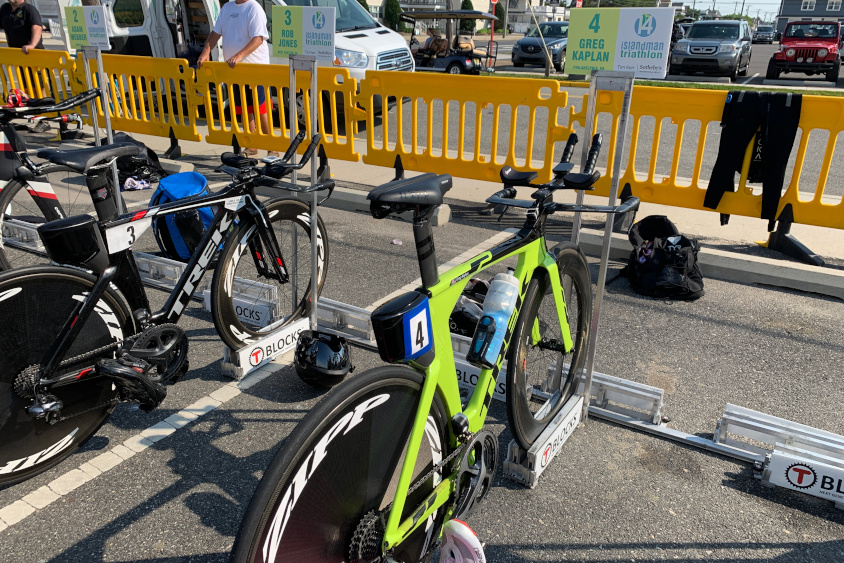
Rack your bike by the nose of the saddle, with the front wheel pointing out. If space permits, move it to the left-most side of your towel or mat, creating space for the rest of your gear. Set up all of your items—shoes, sunglasses, hat, nutrition, race belt with number—in your stall in the order you’ll need them, with the bike items you’ll need first at the bottom edge of your transition area.
A way to quickly and more easily get your feet into your cycling and running shoes is to put a bit of talcum powder in your shoes and, if you wear them, in your socks. Even if your feet are wet, talc reduces friction and leads to fewer footwear struggles.
If you’re a sock-wearer, before you talc your socks, roll them down, from ankle to toe. This way, all you have to do to put them on is get them on your toes, and then unroll them upwards. Leave your socks in your cycling shoes if you bike with them, or in your running shoes if you wait until T2 to put them on. If you clip your cycling shoes into your bike pedals, do this next. If you’re the type of triathlete who does a flying mount onto your bike, now’s the time to rubberband the heels of your tri shoes to your bike.
If you don’t clip your shoes to your bike, put them towards the bottom edge of your transition mat. On top of your shoes, put your helmet with the round side down. Put your eyewear into your helmet. If you stash your helmet on your bike cockpit, ensure it won’t fall off and litter the transition area.
If you wear a visor or a hat, put it under the toes of your running shoes. If your race doesn’t require you to wear a numbered race belt on the bike, put this under your headwear. Put any nutrition you’ll carry on the run with your headgear, so you can easily grab it as you run out of transition.
After you set up your stall, take a walk around the bike in/out and run in/out areas to understand their relative positions in relation to where your bike and gear are. Familiarize yourself with the transition traffic flow so you don’t get confused or run afoul of traffic safety rules.
Take your time in transition. Don’t dawdle, but this is a good time to keep your heart rate low and mentally prepare for the bike and the run. I like the mantra: Slow is smooth; smooth is fast.
Swim-to-bike transition
After finishing the swim, as you’re running towards transition, pull your goggles off and hold them in your mouth while you’re pulling off your swim cap. Holding goggles in your hand while you pull your cap off risks dropping them and slowing you down in a high-traffic area. Put your cap in your mouth, too.
With your cap and goggles in your mouth, your hands are free to unzip your wetsuit if you wear one. Pull your arms from the sleeves and down to your waist. Do this while moving from the swim exit towards transition.
When you get to your transition area, wake your bike computer from sleep mode. (You did power it on and let it go to sleep mode before you left for the swim start, right?) This will make it ready for use while you’re finishing your first transition, without having to wait a long time for a GPS signal.
Next, slide your wetsuit down to your ankles. Pull one foot up and out of your wetsuit, and step on the wetsuit material around the other leg. While you’re stepping out of your wetsuit with one foot, pull the other leg from your wetsuit. Practice this so you won’t trip on race day. Keep your stripped wetsuit to the right of your bike, out of the way of your other gear.
Put on your eyewear, then your helmet. If you wear socks, put your toes into them and then roll them on. If you put on your cycling shoes in transition, stick your feet into them and secure them.
If your race requires you to wear a race belt and number on the bike, do this next. Before you leave transition, make sure all of your gear from the swim and run is in your stall, and not in your or anyone else’s way, which risks a penalty.
Hit the start button on your bike computer and then grab your bike by the cockpit and swiftly move towards the bike-out exit.
Practice these steps before race day: run to your bike, strip off your wetsuit, get into your cycling kit, and run with your bike. If you do a flying bike mount, practice this movement, too.
Bike-to-run transition
If you do a flying dismount, practice this a lot so the movement is a smooth series of steps on race day. You’ll want to unstrap your cycling shoes maybe 500m to 300m before the bike dismount line, and pedal the remaining meters with your feet on top of your cycling shoes. If you don’t do a flying dismount, make sure to keep to the right of the bike-in zone, so you don’t get hit from behind when you stop to dismount your bike. If you need to hit the lap or stop button on your bike computer, do it.
Grab your bike by the cockpit and run with it by your right hip so that you won’t get tangled in the driveside crankarm. As you’re moving towards your transition mat, unclip your bike helmet, but do not yet remove it. If you’re touching your bike, you need to be wearing your helmet or face a race penalty.
When you get to your stall, rack your bike and then remove your helmet. If you’re still wearing cycling shoes, remove them and place them on top of your wetsuit or on the back of your transition mat.
If you plan to wear socks and didn't wear them for the bike portion, now’s the time to roll them on. Slip your feet into your running shoes, which you laced with elastic laces to save additional time in T2.
Cram any nutrition you plan to carry into your kit. Grab any headgear you plan to use on the run and your race belt, if you’re not already wearing it, and move smoothly and swiftly towards the run-out exit. If you don’t wear a hat or a visor, don’t forget to leave your helmet in your transition space. As you’re running out, put on any headgear and then your race belt.
Practice. A lot. If the event requires you to put all of your gear into different bags—bike bag, run bag, non-race bag—and stores the bags on hooks in a dedicated area, practice unbagging your gear, donning it, and moving from swim to bike and from bike to run in race-day simulations.
Top tips for speedy triathlon transitions
- Practice T1 and T2 several times before race day.
- Use a towel or yoga mat to distinguish your transition stall, if allowed.
- Set up your transition stall in reverse order of how you’ll need the items.
- Read the event rules about transition before race day.
- Understand transition geography, landmarks, and traffic flow.