

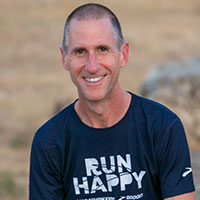

A new year is upon us, and like many of us, we set aspirational goals to become healthier, get in shape, lose weight, live a more active lifestyle, and the list can go on. If you drive by your local gym during the first couple of weeks of January, there won’t be many empty parking spots. But those who started the year with good intentions will invariably fall off the wagon, and the gym’s parking lot will become sparse again.
My running career didn’t start as a New Year's Resolution. In fact, it started on the other and more inopportune side of the calendar – smack dab in the middle of July in Central Texas when it’s hot as Hades and humid as all get-out. I’d reached a point where I needed some resolutions, not unlike those I’ve listed above. I’d reached a point where I was overweight for my frame. My diet was garbage. I overindulged with alcohol daily. I knew I was unhealthy. And for me, the important thing was to try to stay alive for as long as I could for my two young daughters. I knew I’d reached a tipping point where if I didn’t do something soon, I was probably going to find myself receiving bad news from a doctor.
Why Trust Us?
ACTIVE.com's editorial team relies on the knowledge and experience of fitness and wellness experts, including competitive athletes, coaches, physical therapists, nutritionists, and certified trainers. This helps us ensure that the products we feature are of the highest standard. Collectively, the team has spent countless hours researching equipment, gear, and recovery tools to create the most accurate, authentic content for our readers. Customer satisfaction is also a key part of our review process, which is why we only feature highly rated products.
I’ll spare you the story of how I decided to go for a run. Still, I'll indulge you with how I set small, attainable goals early in my running journey and how that methodology carried over into becoming a much more experienced runner. But before I get into all the simple nitty-gritty, the very first thing you should always, always, ALWAYS remember is this: keep it simple. Running doesn’t need to be complicated. I don’t remember when I started walking, but if I had to guess, it was probably around the same age as my own children, which was around the one-year mark. That might be around the same time that you learned how to walk as well. And as I observed my own children, friends’ children, and relatives’ children growing up, one of the first things they do when they get a pretty good grasp of walking is try to move faster. They start to run. Nobody teaches a toddler about biomechanics, stride length, cadence, or lactate threshold. They just lean forward a bit, put one foot in front of the other a little faster, and swing their arms. That’s it. If there’s one thing to remember to set and stick with a running goal, it’s to keep it simple. Running is simple. We were born and designed to do it. No need to overcomplicate it.
In the spirit of simplicity, keep your running goal(s) simple as well. What has worked for me, and for runners I have coached, is to set a simple, attainable short-term goal that is either distance- or time-based. When I’d reached that tipping point where I knew I needed to do something to get healthy and prolong my life, I decided to go to the local middle school track on a day when no one else was around and run one mile. I knew that four laps around a standard track was roughly a mile, so I tasked myself with "running" a mile. And I timed myself because 1) I had no idea how long it would take me to run a single mile, and 2) I knew that if I didn’t die while running that mile, I wanted an immediate baseline of some sort.
That one mile didn’t kill me. In fact, I kind of enjoyed it. Kind of. I immediately committed to returning to that same track and running another mile the next day. But I wanted to make sure I enjoyed it a little more, so I committed to running that mile a little more slowly. And that’s precisely what I did the next day. And all this while I’d remembered hearing or reading that we modern humans should get at least 20 minutes of cardiovascular exercise on a daily basis. Now, I wasn’t "fast," but my one-mile jog wasn’t taking me 20 minutes, so on the third day I switched my running commitment to a time-based goal. On the third day, I ran (slowly) for 20 minutes. Running for 20 minutes was difficult for me at the time, but that simple time-based goal was what I stuck to for quite a while, until running 20 minutes became a little easier. My strength and endurance improved, and before long, I noticed I was getting very close to covering two miles in 20 minutes. And that’s when I decided to change my running commitment to a distance-based goal. My new goal was to run two miles. And so I started running two miles on the days that I ran (with a healthy mix of a couple of days off during the week for rest and recovery).

The trick was to be consistent and keep it simple. I’d change my goal to better align with my progress and to motivate and push myself naturally. Two miles became three miles. Twenty minutes became 30 minutes. Switching between time-based and distance-based goals made the commitment sustainable and the outcome attainable. And it was simple. I would observe my improvements and switch the goal at an obvious point. When I saw I was getting close to meeting my time-based goal of 5 miles, I changed my goal to running 5 miles on my run days.
To summarize how to set running goals in the New Year, give yourself either a distance-based or a time-based goal to start, start there, keep it simple, and then switch the goal to either distance or time-based on your initial goal whenever it feels right for you to switch. Don’t rush it. Remember, we’re keeping it simple.
And one final nugget of advice in that spirit of keeping it simple: don’t get caught up in running media, especially of the social variety. Comparison is the thief of joy. This is your experience. Take it slow, keep it simple, and believe me, you’ll look back in the not-too-distant future, and you’ll be glad that you did.