
The Importance of Building a Running Base

Base Training

If you have even the most basic knowledge about running, you probably know heading out for a 20-mile run would be nearly impossible if you haven't worked up to that point.

Base Training: The What and Why

Base training is the first phase of a larger training concept called periodization, which involves a sequence of training blocks culminating in a single peak performance. The concept was first introduced in the 1960s by Arthur Lydiard, a charismatic New Zealander with a knack for creating Olympic running champions.

Former Olympian and noted running coach Jack Daniels recommends base training for new runners and runners who are coming back to the sport after a break of a few weeks or months.

Base training is built around the slow, long-distance run. By running successively longer distances, runners build up their aerobic capacity by expanding capillary growth around muscle cells for efficient oxygen delivery. This gradual progression will also strengthen connective tissues and build up a runner's resistance to common running injuries.

Together, these physical adaptations prepare runners for more strenuous training and racing.

Take a look at the below chart, showing Lydiard's theory of base training. The pyramid shape allows the base to be widened or narrowed depending on your goals and timeline.
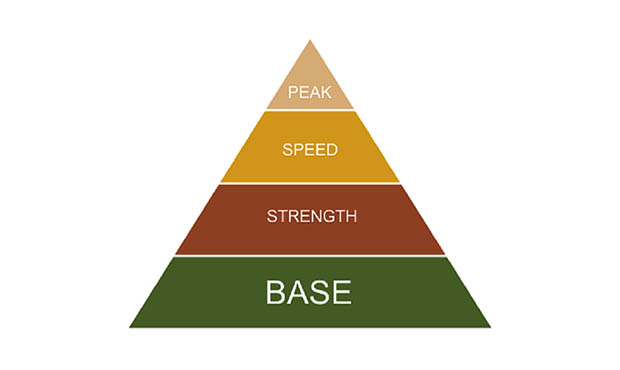
Lydiard's Training

With the idea that a bigger base can support a taller peak, it's easy to see how a strong base can lead to faster running at your peak.

How To Build Your Base

During base training, runners should keep their intensity at moderate levels. In Jack Daniels' book Daniel's Running Formula, he describes this type of easy running as 59 to 74 percent of VO2 max, or about 65 to 78 percent of maximum heart rate. (Not sure what VO2 max means? Here's more information.)

Base training, however, doesn't have to be made up entirely of slow running.

There's a common misconception surrounding Lydiard's training pyramid, says USATF certified running coach Greg MacMillan. Each phase is not strictly one-dimensional; the general focus is what's most important.

Don't be afraid to include strides or strength work in your training plan, but keep your focus on building up endurance at an easy pace.

Many runners find the base-building phase to be their least favorite part of training. The long runs are not only physically demanding, but also mentally exhausting. Sometimes it's difficult to stay focused and enjoy runs when you're out there for more than an hour or two.

But, this too is part of the base-building phase. It takes extraordinary discipline and mental toughness to push yourself on race day. If you know you've done it in training, you can feel good about achieving your finish line goals.

Not every runner needs to follow a complete training plan built upon Lydiard's periodization concept. Many runners will be happier simply running by intuition. But if you want to conquer longer distances, you should begin by building a solid running base.

Related Articles:

Connect with us on Twitter, Facebook, Instagram or Pinterest for more tips, recipes and ideas to fuel your ACTIVE life.

Active logoFind your next race.

Get ACTIVE on the Go

Couch to 5K®
Couch to 5K®

Couch to 5K®

The best way to get new runners off the couch and across the finish line of their first 5K.

Available for iOS | Android

Latest In Running

Connect With Us

Does Running Shoe Type Really Matter?

Do types of running shoes matter?

Runners have strong opinions about nearly everything related to running, and one of the most hotly debated topics is shoes. Minimalist or maximalist? Neutral, stability or motion control? Elevated heel or zero-drop? The choices seem endless—and confusing.

But does the type of shoe really matter that much? To find out, we spoke with physical therapists and running shoe specialists for their take.

Neutral, Stability or Motion Control? It Doesn’t Matter

Ten years ago, running shoe debates focused on a runner’s favorite brand and his or her designated type of support structure. For a long time, shoe companies have asserted that runners had to match their foot type to a shoe’s level of support. Runners with “perfect” feet and form got to enjoy wearing a relatively light, flexible and cushioned neutral shoe, while those with flat feet or who tend to overpronate were relegated to wearing the running shoe equivalent of combat boots.

However, research published within the past decade has shown that there is little to no benefit in wearing stability or motion control shoes versus neutral shoes. In fact, some experts contend that runners who rely solely on shoe type to fix their injuries are likely making things worse.

Good Running Mechanics—Not Shoes—Prevent Injury

Many runners too often rely on the “right pair” of running shoes to address their injuries, says Denise Smith, a licensed physical therapist, Certified Running Technique Specialist and the owner of Smith Physical Therapy and Running Academy.

“Runners—and especially new runners—get lots of advice from friends, and one of the first things a friend will say is, ‘You need new shoes,’” Smith says. Instead of rushing to your nearest running store, she recommends addressing poor running mechanics.

“New runners and those prone to injury would be better served by spending some time with a running technique specialist to get their form down, and then find the shoe that’s right for them,” she says.

Andrew Walker, a physical therapist and owner of PhysioWorks Sports and Wellness, echoes Smith’s sentiments.

“People are often prescribed shoes based on a trend, their arch height, or amount of pronation, but the research just doesn’t bear it out,” Walker says.

Walker specializes in running gait analysis, injury prevention and rehab, so he has seen foot problems of all kinds.

“I think the word ‘pronation’ has become demonized. It’s actually a shock absorbing mechanism,” he explains. “I’ve seen patients placed in a stability or motion control shoe that has limited (their) pronation too greatly and may have actually contributed to their injury.”

Better Buying Advice

So if recent scientific data and today's running experts are saying that shoe type doesn’t really prevent injury, how has this myth managed to survive for so long?

"Trends come and go," Walker says. "But none of them have been shown to reduce injury."

He adds that the research surrounding barefoot, minimalist, traditional and maximalist shoe options has largely come to the same conclusion: It’s the runner’s mechanics, not the type of shoe on his or her feet, that cause or prevent injury.

Walker notes that for some runners with specific injuries, a gradual progression from one type of shoe to another can have favorable results, but only if overall running mechanics are modified in conjunction with the shoe change. Runners should avoid switching to a drastically different type of shoe and running the same number of miles with the same running form.

What Should You Care About Then?

Despite the evidence against running shoes preventing injury, this is not to say that running shoes don’t matter. Walker recommends going to a specialty running shoe store and trying on lots of shoes.

"(You should) actually run in them on the treadmill," he stresses. "Pick the most comfortable pair in terms of support and your foot’s preferred path of movement."

He explains that your feet should be allowed to move the way they naturally want to, rather than be forced into a so-called “normal” position.

Smith, the physical therapist and Certified Running Technique Specialist, has similar advice for runners. She stressed the value of a good running shoe and a good running shoe store. When it comes to choosing footwear, she tells her patients to consider three important C’s: comfort, cushioning and color.

“Comfort is the most important feature of a running shoe,” she says. A shoe should fit well and feel good on the foot while you are running.

As for cushioning, Smith cautions that a shoe should not have too much.

“People tend to use cushioning to alleviate pain and absorb shock,” she explains, asserting that good form is much more important than shoe type when it comes to distributing ground reaction forces. To help her clients learn to feel those impact forces and how foot strike and stride can alter them, she occasionally has them do running drills barefoot in the grass. This let runners feel the natural dispersion of impact without a shoe involved.

The third “C” of Smith’s running shoe rules, color, is less scientific. When you’re happy with the appearance of your shoe, you’re more likely to feel better overall.

The next time you find yourself staring at endless rows of running shoes, follow Walker and Smith’s advice. Find a friendly, knowledgeable sales clerk, then grab a seat, get comfortable and try on as many shoes as it takes to find your perfect pair.

Or, if you'd prefer to shop from the comfort of your own home, let the Shoe Dog identify the perfect shoe for you.

Active logoREAD THIS NEXT: The ACTIVE Spring Shoe Guide

Connect with us on TwitterFacebookInstagram or Pinterest for more tips, recipes and ideas to fuel your ACTIVE life.

Get ACTIVE on the Go

Couch to 5K®
Couch to 5K®

Couch to 5K®

The best way to get new runners off the couch and across the finish line of their first 5K.

Available for iOS | Android

Latest In Running

Connect With Us

How to Properly Hydrate for Summer Running

Summer weather brings a distinct set of challenges to the table for runners. While warmer temperatures offer a chance for runners to shed layers, soak up Vitamin D and use trails that are snow-covered during the winter months, they also pose the risk of dehydration. Hot and humid conditions don't have to be a runner's enemy; learn how to properly hydrate so you can make the most of your summer training.

Humidity and Sweat Rate

Heat and humidity are separate elements that work together to put your body into overdrive as you run. For runners who train in humid areas, high heart rates and excessive sweating can be daily struggles.

A warm temperature is far more dangerous in a humid climate than in a dry one. Humidity slows the evaporation process of sweat from the skin, making it difficult for the body to cool itself.

More: 9 Possible Reasons Why You're Sweating So Much

The most important thing about running in the heat and humidity is to adjust your pace, understanding that the added stress of humidity on the body requires you to slow down a bit. This way, you keep your perceived effort at the level it would be on a cool, dry day.

How Much Water?

There are many factors that influence sweat rate, including the surface area of the athlete's skin, genetics, diet and environment. On average, most runners shed somewhere between half a liter and two liters of sweat per hour of exercise. As a rule of thumb, you want to be consuming about 25 ounces of fluid per hour that you're running (use a water bottle that shows measurements on the side). This is particularly important for long runs when you are out in the hot summer sun for more than an 80 minutes.

Of course, drinking too much water at a time can lead to overhydration, diluting your electrolytes, so drinking a caloric, electrolyte sports drink in addition to water helps to balance out your body's needs as you run.

How important are electrolytes?

Electrolytes serve to keep your digestive, nervous, muscular and cardiac systems balanced and firing on all cylinders. When electrolyte levels in the body are imbalanced, they can cause cramping and fatigue. Severe imbalances can result in lightheadedness, nausea, joint aches and dry skin.

While you're running, you lose sodium and potassium (key electrolytes) through your sweat, which is why runners need to replenish with an electrolyte sports drink such as Powerade or Gatorade. You can also try an option with less sugar like Nuun electrolyte tablets.

More: What to Eat Before a Run

Are You Hydrated?

A good way to make sure you are hydrated enough is to check your urination habits. An average, a healthy adult urinates five to eight times each day. The color of your urine should be a light, pale yellow. Long runs and hard workouts are especially taxing on the body, so take special note that your urine does not get too dark on those days.

Another option to test your body's hydration that doesn't involve looking in the toilet is a skin pinch test. Pinch a small section of skin on the back of your hand and let go—it should snap back to flat quickly. If the pinched skin stays tented for a few seconds, you could be dehydrated.

More: Keep Your Cool: A Runner's Guide to Heat and Hydration

Connect with us on Twitter, Facebook, Instagram or Pinterest for more tips, recipes and ideas to fuel your ACTIVE life.

Active logoFind your next race.

Get ACTIVE on the Go

Couch to 5K®
Couch to 5K®

Couch to 5K®

The best way to get new runners off the couch and across the finish line of their first 5K.

Available for iOS | Android


Latest In Running

Connect With Us