
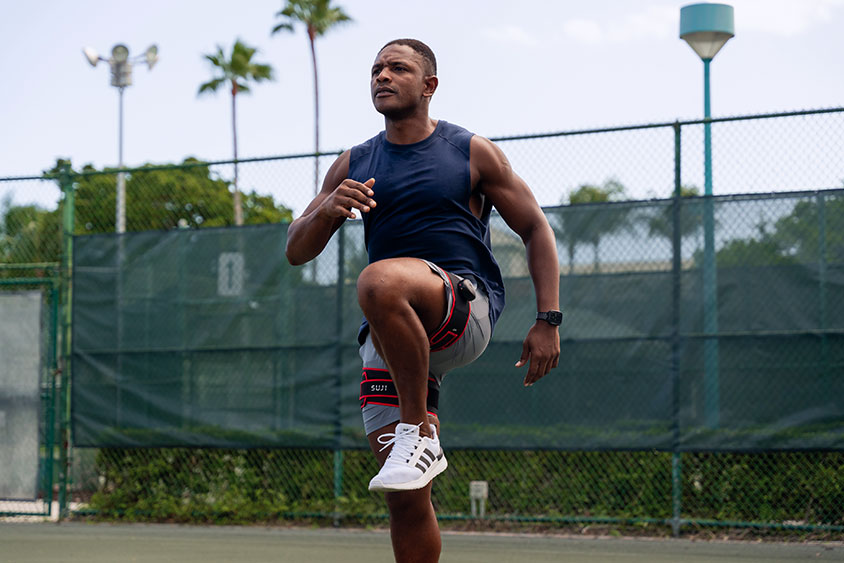
Quick answer: Suji's new Muscle Score uses app-connected arm and leg compression cuffs to generate separate 0-100 ratings for upper- and lower-body muscle performance. The guided assessments use push-ups and bodyweight squats, but the score reflects performance rather than muscle mass and is currently available in beta to Premium subscribers.
Why Trust Us?
ACTIVE.com's editorial team relies on the knowledge and experience of fitness and wellness experts, including competitive athletes, coaches, physical therapists, nutritionists, and certified trainers. This helps us ensure that the products we feature are of the highest standard. Collectively, the team has spent countless hours researching equipment, gear, and recovery tools to create the most accurate, authentic content for our readers. Customer satisfaction is also a key part of our review process, which is why we only feature highly rated products.
Wearable technology can tell us how long we slept, how many steps we took, how fast our heart is beating, and whether we're supposedly ready for another hard workout. But for all the numbers now available on our wrists and fingers, muscle performance isn't something most of us routinely measure.
Suji wants to change that.
The maker of app-connected blood flow restriction (BFR) cuffs recently introduced Muscle Score, a feature that assigns separate 0-to-100 scores to upper- and lower-body muscle performance. Instead of requiring a trip to a performance lab, the assessment is designed to be completed at home with Suji's arm or leg cuffs and a couple of familiar bodyweight exercises.
The feature launched November 2 and is currently available in beta through the Suji app for Premium subscribers.
ACTIVE has received the Suji cuffs for future testing, but we haven't put the system through a full evaluation yet. For now, here's what the technology claims to measure, how the assessment works, and why the idea could be interesting for athletes.
What Is Suji?
Suji isn't a traditional wearable like a GPS watch, heart-rate monitor, or smart ring. The system consists of connected compression cuffs worn around the arms or legs and controlled through a companion app.
The cuffs are designed around blood flow restriction training, commonly shortened to BFR. Instead of relying exclusively on heavy resistance, BFR training uses controlled pressure applied to a limb while the user performs lower-load exercise.
Suji positions its system as a way to incorporate this type of training without the heavy loads associated with conventional strength workouts. The company's recommended core program consists of three 15-minute sessions each week.
The hardware itself isn't new, but Muscle Score adds another dimension to the system: measurement.
What Is Suji Muscle Score?
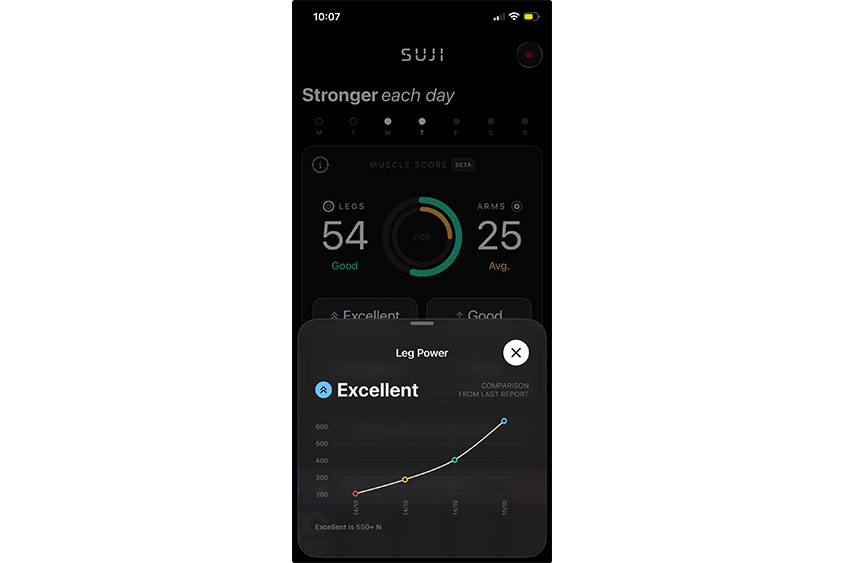
Muscle Score is Suji's attempt to turn muscle performance into an easily understood metric, much like the sleep, recovery, and readiness scores that have become common across wearable platforms.
Users receive separate scores from 0 to 100 for their upper and lower body.
According to Suji, Muscle Score evaluates several aspects of performance during an assessment, including movement quality and power output. The company's public description also says the score accounts for symmetry.
Rather than viewing a single result in isolation, the idea is to establish a baseline and monitor how the score changes over time.
That distinction matters.
A score like this shouldn't be confused with a direct measurement of how much muscle someone has. Suji is assessing aspects of muscle performance, not performing a body-composition scan or directly measuring skeletal muscle mass.
How Does the Muscle Score Test Work?
The assessment is deliberately simple.
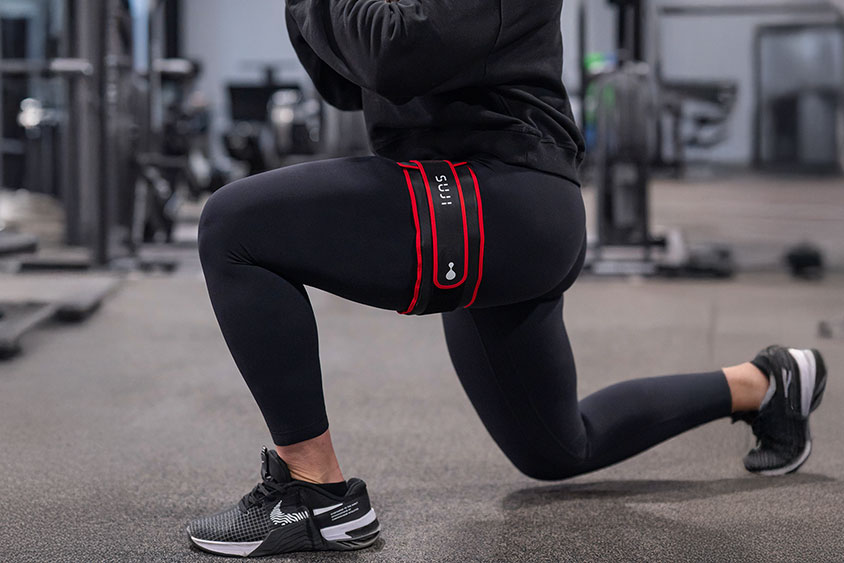
For the lower-body score, users put on Suji's leg cuffs and perform guided bodyweight squats. For the upper-body assessment, users wear the arm cuffs and perform push-ups.
Sensors in the system collect information about the exercises, which Suji uses to generate the corresponding score.
The company says the assessment considers factors such as repetition performance, movement consistency, force production, and how performance changes as the user fatigues.
You also don't necessarily need the complete arm-and-leg system to use the concept. Someone who owns only the leg cuffs, for example, can assess the lower body independently rather than needing to purchase both sets before establishing a score.
That could be particularly relevant to endurance athletes who are primarily interested in monitoring their legs.
Why Could Muscle Performance Matter for Athletes?
The appeal of Muscle Score isn't necessarily the number itself. It's the possibility of observing how that number changes.
Consider a runner deep into a marathon training block. GPS data can show mileage and pace. A smartwatch may monitor heart rate and sleep, while another wearable might generate a recovery or readiness score.
But none of those metrics directly answer a different question: How are my muscles performing?
That's the gap Suji is attempting to address.
In theory, repeated assessments could give users another data point alongside their existing training metrics. An athlete could establish a baseline when rested and then observe whether performance moves up or down during different phases of training.
That could make the concept relevant beyond traditional strength athletes.
Runners and cyclists, for example, accumulate significant lower-body training volume but may not have an objective strength or muscle-performance metric built into their everyday tracking ecosystem. Likewise, someone adding strength work to a running program may want a way to follow changes that aren't reflected by pace, distance, or heart rate.
The key question is whether Muscle Score ultimately provides information athletes can act on, rather than simply another number to check.
That's something we'll be paying attention to when we test the system.
Quick tip: If you plan to track Muscle Score over time, test under similar conditions whenever possible. Time of day, recent workouts, sleep, illness, and recovery status could all affect daily performance.
Is Muscle Score the Same as Measuring Muscle Mass?
No. This is where some nuance is needed.
It's tempting to think of a 0-to-100 "Muscle Score" as a comprehensive grade for muscle health, but that's broader than what the underlying assessment appears to represent.
The system does not replace a DEXA scan or other methods used to assess body composition, nor should a consumer score be interpreted as a medical diagnosis.
This distinction becomes particularly important around applications such as weight loss and healthy aging. Suji suggests Muscle Score could help users observe muscle performance during periods when maintaining muscle is a priority, including for people taking GLP-1 medications.
Potentially useful? Yes.
But changes in a performance score aren't the same as directly measuring changes in muscle mass.
For athletes, thinking of the number as a repeatable performance metric rather than a definitive grade for the health of every muscle in your body may be the more useful way to interpret it.
Quote & Author:
A quick test with the cuffs shows how your muscles are performing and whether your training is working, and you never have to lift a heavy weight.
Could Muscle Score Work Like a Recovery Score?
There's another interesting element to Suji's approach: Muscle Score isn't necessarily supposed to increase every time you test it.
The company says the score reflects performance on the day of an assessment. Training load, recovery, illness, and other factors may therefore be reflected in changes between tests.
That makes Muscle Score conceptually closer to some of the metrics athletes already follow with wearables.
One unusually low reading might be less meaningful than the longer-term pattern. Establishing a personal baseline and observing trends over several weeks potentially provides more context than chasing a perfect 100. Understanding how training and recovery work together can also help put day-to-day changes into context.
Again, whether those fluctuations prove reliable and useful in real-world training is something that requires hands-on testing.
How Much Does Suji Cost?
Suji isn't an inexpensive addition to your training kit.
The company currently lists its Complete Kit, which includes two devices plus two arm and two leg cuffs, for $749. Suji also says the system is HSA/FSA eligible.
Muscle Score is currently offered in beta through the company's Premium subscription. According to information provided by Suji, Premium costs $4.99 per month after a 30-day free period and adds features including training programs, an exercise library, recovery sessions, and Muscle Score.
The Suji app also has a free tier for basic device control.
For athletes considering the system primarily for Muscle Score, that creates an important value question: Does the additional muscle-performance data justify buying specialized hardware and adding another subscription?
That's difficult to answer without actually living with the system for a while.
What Is the ACTIVE Takeaway?
There's no shortage of fitness data.
For many athletes, the bigger problem is figuring out which numbers actually deserve their attention.
That's what makes Suji's Muscle Score interesting. Instead of measuring another variation of daily activity, heart rate, or recovery, the system is attempting to quantify something that typically isn't part of the consumer wearable dashboard: how your muscles perform during a standardized exercise assessment.
The concept has potential for runners, cyclists, strength athletes, and active adults who want another way to follow their training over time.
But the real test isn't whether Suji can generate a number from 0 to 100. It's whether that number proves consistent, understandable, and useful enough to influence how someone trains and recovers.
We'll get a better sense of that when we put the Suji system through hands-on testing.
Frequently Asked Questions About Suji Muscle Score
What does Suji Muscle Score measure?
Suji says the score evaluates upper- or lower-body muscle performance using factors that include repetition performance, movement consistency, force production, fatigue, movement quality, power output, and symmetry.
Do you need both the arm and leg cuffs?
No. Owners of the arm cuffs can complete the upper-body assessment, while owners of the leg cuffs can complete the lower-body assessment. The Complete Kit supports both.
Does Muscle Score measure muscle mass?
No. Muscle Score is a performance metric generated from guided exercise assessments. It is not a direct measurement of skeletal muscle mass or body composition.
What exercises are used for the test?
Suji uses push-ups for the upper-body assessment and bodyweight squats for the lower-body assessment.
Is ACTIVE's article a hands-on Suji review?
Not yet. ACTIVE has received the cuffs but has not completed a full evaluation. A future hands-on review will examine setup, comfort, training sessions, score consistency, and overall value.