


Most athletes know that rest days are essential to recuperate and perform at a high level. Your body needs rest to repair muscles and synthesize proteins, otherwise you would always be in a state of breaking down. However, rest days shouldn’t always involve sitting around doing nothing. You should be helping your body recover for your next workout with massages or stretching. This helps to increase blood flow, increase range of motion, eliminate toxins, and decreases muscular tension by reducing trigger points and scar tissue that builds up over time.
While frequent massages could be costly, a self-massage can be performed in the privacy of your home for a one-time price with the help of a foam roller. Foam rollers are cylinder-shaped styrofoam, which alleviate muscular tension and improves flexibility for less than $20. The concept is very simple: use your bodyweight to apply pressure to sore spots.
Here’s how it’s done:
1. Place the roller at the origin of the muscle you want to loosen up, then gradually roll down.
2. When you reach a tender area, stay there for about one to two minutes and breathe, allowing your body weight to sink into the roller.
3. Although uncomfortable at first, try to maintain pressure on tender areas until the pain subsides by 50 percent.
4. Once the area feels better, continue rolling regularly to keep the area relaxed.
5. Work your way down to other tender spots and repeat the procedure.
6. Continue rolling up and down over the whole muscle as desired.
How It Works
Self-massage on a foam roller works through a process called autogenic inhibition. Autogenic inhibition is a protective mechanism, preventing muscles from exerting more force than the bones and tendons can tolerate. At all muscle-tendon junctions there are tension receptors called Golgi Tendon Organs (GTO). When tension in a muscle increases too much to the point of injury, the GTO relaxes the muscle. When you roll on the foam, you stimulate muscular tension and this mechanism kicks in. This relaxes stiff muscles, diminishes trigger points, increases circulation and increases range of motion.
Common Muscles to Work on the Foam Roller
Glutes/Piriformis
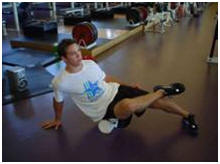
Roll back and forth starting from the top of the buttocks to the top of the hamstrings.
Hamstrings
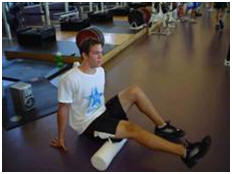
Roll back and forth starting from your buttocks down to the knee.
Quads
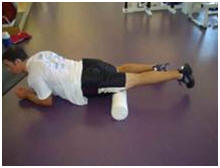
Roll back and forth starting from the upper thigh down to the knee
Calves
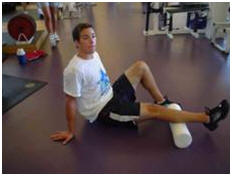
Roll back and forth starting from the back of the knee to the Achilles tendon.
Lats
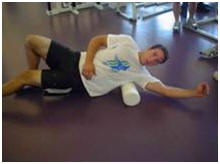
Roll back and forth starting from the under arm to your mid torso.
IT Band
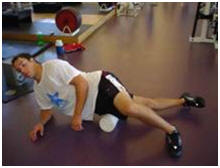
Lying on the side of your leg, roll starting from the top of your hip to the knee.